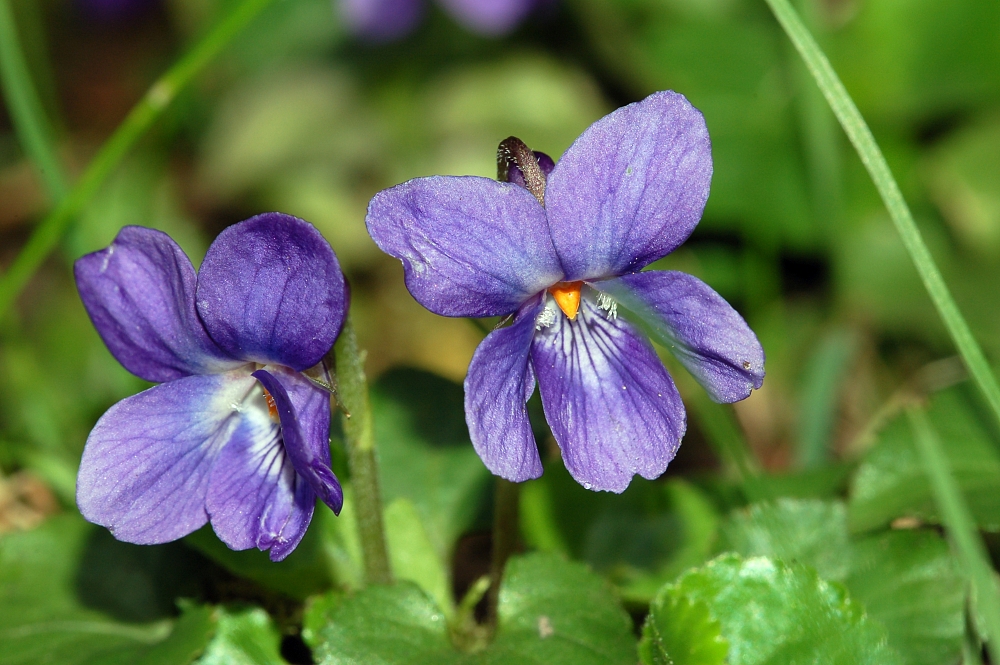
Violet has a nostalgic sweetness that is both delicate and profound.
There are hundreds of species of violets -but only a few have the fragrance and perfume that we are looking for. The variety “Viola odorata” (English violet or garden violet) has been used for culinary purposes since at least Roman times and this is the varietal used as food flavouring.
Violet flavoured sweets and candy were very popular in the 19th and early 20th century. Even medicines and throat lozenges were available in violet flavour back then.
Unfortunately, sometime in the middle of the 20th century violets just vanished from the food industry. The massification of use of synthetic food flavours, with their advantage of a negligible cost to the manufacturer, is the root cause behind this.
For violet flavours, the synthetic flavour ionone replaced natural violet flavour. The problem is: the two do not taste the same.
Natural violet flavour is complex, elegant and subtle, but the flowers are expensive to process. Ionone, on the other hand, is very economical in bulk, but has been associated with the smell of cheap bathroom cleaning products and air fresheners.
Nowadays, violets are a niche flavour for the specialist chocolatier. The delicate floral notes demand a dark high-quality chocolate to work with.
The Nature of Violets
Violets are:
- Floral: Subtle floral notes.
- Sweet: It has a hint of honey and pollen.
- Bitter: A slight bitterness that complements the bitterness of dark cocoa.
- Aromatic: Its essential oils are volatile when captured correctly.
To safeguard the delicate notes of natural violets, the method of infusion is critical to capture the essence.
Let’s explore on how to use them in bonbon preparation.
Violet Dark Chocolate Bonbons
Before you start: never chop the violets. The residue of the flowers will create severe problems in your ganache and your bonbons will suffer from the unwanted flower debris. More importantly, you may lose the essential aromas which is a major problem that affects all florals handled incorrectly.
Ingredients
- Couverture: Dark chocolate, preferably with berry or floral notes. A high-grade Venezuela, Ecuador or Tanzania chocolate, with 70% cocoa or more.
- Filling:
- 200g heavy cream (35% fat)
- 25g dried edible violet flowers
- 200g 50% white chocolate, chopped
- 50g unsalted butter, softened at room temperature
While other recipes call for adding essential oils and imitation flavours, we believe that this will not result in the best experience.
Process
These bonbons are a challenging project for the home chocolatier: it has to be planned into three separate phases: preparation of the ganache, preparation and moulding of the couverture, and filling and capping of the bonbons.
Take your time. Work slowly. And for the first couple of tries, use affordable ingredients: you do not want to ruin a kilogram of Venezuela’s superb (and expensive) dark chocolate.
The mould and shells should go into the fridge before filling with the ganache: this is very important, as the filling step requires the ganache to be warm. And remember to reserve couverture to cap the shells after filling the bonbons and setting them in the fridge.
Step 1. Creating the shells.
The process is the same as any other single cocoa bonbon: melt, temper and fill the moulds. Use a lower price chocolate for the first couple of batches, until you feel confident in your results: a generic 60% blend will work nicely.
Place the moulds in the fridge to harden for an hour before moving onto the next step.
Step 2. The ganache.
- Bring the cream to a simmer (60 to 80 C – 140 to 175 F). Remove from the heat, add the dried violets, cover, and let infuse for 20 minutes.
- Strain the cream through a fine-mesh sieve, gently pressing on the flowers to extract all the flavour. Use the handle of a wooden spoon or a wooden dowel for this.
- Pour the warm violet-infused cream over the chopped chocolate. Let it sit for a few minutes, and then start emulsifying the ganache by gently stirring.
- Allow the ganache to cool to 40 °C (105°F), then incorporate the soft butter. You may add a few drops of oil-based food colouring; blue or violet. Continue stirring gently until the temperature drops to 30°C (85°F)
Step 3. Filling and capping the shells - Use a piping bag or a pastry syringe to fill the cold bonbon shells with the ganache. As the mould with the shells is cold, the dark couverture will not be disturbed by the warmer ganache.
- Take the mould with the filled shells back into the fridge for another hour.
- Close the bonbons (cap) using the same variety of couverture you prepared for the shells, properly melted and tempered. This will be much easier with left over chocolate from the first step, as it is already tempered and almost ready to use.
Final Thoughts
The dark chocolate gives way to a smooth floral filling. The dark chocolate couverture prevents it from being cloying, creating a sophisticated and memorable bonbon.
Violet dark chocolate bonbons are a challenging and satisfying exercise in finesse.
Your curiosity is the first ingredient of a masterpiece.
Do not be afraid to steep, taste, and create